CCA, or Cold Cranking Amps, measures how much power a car battery can deliver to start your engine in freezing temperatures. Understanding CCA helps you pick the right battery, especially if you face cold winters, and prevents those frustrating no-start mornings when you need your car the most.
I've spent years working with car batteries, from testing them in freezing garages to helping friends replace the wrong ones. Let me walk you through everything you need to know about CCA so you can make smart choices for your vehicle and avoid being stranded when the temperature drops.

What Does CCA Actually Mean on a Car Battery
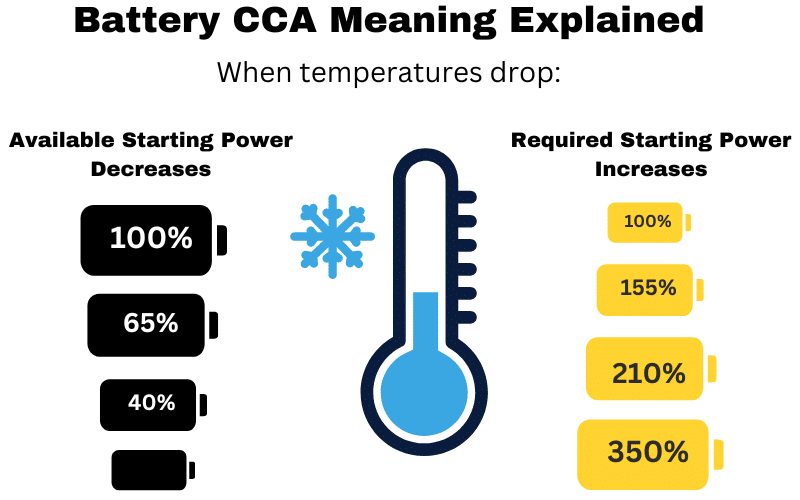
CCA stands for Cold Cranking Amps, and it tells you how many amps a fully charged 12-volt battery can push out for 30 seconds at 0°F (that's -18°C for my metric friends) while keeping voltage above 7.2 volts. Think of it as your battery's muscle power during a freezing cold morning when your engine oil is thick like honey and your starter motor is begging for help.
Here's the thing most people don't realize. Your battery doesn't lose power evenly as temperatures drop. At 32°F (0°C), your battery loses about 20% of its strength. At 0°F (-18°C), it loses around 35%. At -20°F (-29°C), you're looking at nearly half your starting power gone. That's why CCA matters so much in colder climates.
The number itself is tested under strict conditions. Battery manufacturers put their products through standardized tests to get those CCA ratings you see on the label. A battery rated at 600 CCA can deliver 600 amps for 30 seconds in freezing temps without dropping below that critical voltage threshold.
Let me give you a real example. Last winter, my neighbor kept wondering why his truck struggled on cold mornings even with a "new" battery. Turns out he grabbed one with only 400 CCA when his truck needed at least 650. The label said it was powerful, but it wasn't powerful enough for his engine in cold weather. Lesson learned: always match CCA to your vehicle's requirements.
Why CCA Matters More Than You Think
You might wonder if CCA really makes a difference if you live somewhere mild. The answer is yes, but how much depends on where you drive and what you drive.
Cold weather is the main enemy of battery performance. Chemical reactions inside your battery slow down in the cold, making it harder to push out those cranking amps. If you've ever turned your key on a frosty morning and heard that sad, slow cranking sound, you've experienced low CCA firsthand.
But here's something interesting. CCA also affects battery life in general. A battery that frequently struggles to start your engine works harder and wears out faster. It's like asking a person to run a marathon when they're out of shape. Sure, they might finish, but at what cost?
Hot climates matter too, just in a different way. While high temperatures actually increase CCA temporarily, they speed up internal corrosion and water loss. This means your battery might start strong in Phoenix heat but die young because the heat damaged the internal plates.
Different engines need different CCA levels. A small 4-cylinder sedan might start fine with 400-500 CCA, but a big V8 truck could demand 700-900 CCA or more. Diesel engines are especially power-hungry and often need 800+ CCA because of their high compression ratios.
How to Find the Right CCA for Your Vehicle
Finding the perfect CCA rating isn't about buying the highest number you can afford. It's about matching your battery to your engine, climate, and driving habits.
Check your owner's manual first. It will list the minimum CCA your vehicle needs. This is your baseline. Going below this number risks starting problems, especially in cold weather.
Consider your climate zone. If you live in Minnesota or Maine, aim for the higher end of your battery's CCA recommendations. If you're in Florida or Southern California, the minimum requirement might be perfectly fine since you'll rarely see freezing temperatures.
Think about your driving patterns. Short trips don't give your alternator enough time to fully recharge your battery. If you mostly drive 10 minutes to work and back, you might want extra CCA as a buffer for the additional strain.
Add accessories to your needs list. Heated seats, powerful sound systems, and aftermarket electronics all draw power. While CCA specifically measures starting power, a stronger battery handles these accessories better without compromising your starter's needs.
I remember helping my brother pick a battery for his old Honda Civic. The manual said 400 CCA minimum. He lived in Atlanta, drove short distances, and had no extra electronics. A 500 CCA battery worked perfectly for him for over five years. Meanwhile, my friend in Chicago with the same model needed 600 CCA to handle the brutal winters.
Understanding Battery Labels and Specifications
Battery labels can look like a secret code if you don't know what you're reading. Let me decode the common terms you'll encounter.
CCA is the Cold Cranking Amps rating, which we've covered thoroughly. This is the most important number for most drivers.
CA or MCA means Cranking Amps or Marine Cranking Amps. This rating is tested at 32°F (0°C) instead of 0°F. CA numbers are always higher than CCA numbers because warmer temperatures are easier on batteries. A battery with 750 CA might only have 600 CCA.
RC stands for Reserve Capacity. This tells you how many minutes your battery can run essential accessories if your alternator fails. It's measured at 25 amps discharge until voltage drops too low. More RC means more backup power for your lights, radio, and other electronics.
AH means Amp Hours. This is the total energy stored in your battery. Think of it as your battery's fuel tank size. Higher AH means longer runtime for accessories when the engine is off.
BCI Group Size indicates the physical dimensions and terminal placement of your battery. This ensures the battery physically fits your vehicle's tray and that the terminals line up with your cables.
Here's a comparison to make it clearer:
-
A battery rated 650 CCA, 810 CA, 100 RC, 55 AH is telling you it can deliver 650 amps for 30 seconds at 0°F, 810 amps for 30 seconds at 32°F, run accessories for 100 minutes if needed, and holds 55 amp hours of total energy.
-
Another battery rated 750 CCA, 940 CA, 120 RC, 70 AH is stronger across the board but likely costs more and weighs more.
Common Myths About CCA You Should Ignore
Let me bust some myths that lead people to make bad battery choices.
Higher CCA won't hurt your car. Some folks worry that too much power will damage their starter or electrical system. This is simply not true. Your starter draws only what it needs. Extra capacity is like having a bigger gas tank. Your car won't use more fuel just because the tank is larger.
All batteries with the same CCA perform equally. This is misleading. Build quality, plate design, and warranty matter just as much. I've seen cheap batteries with high CCA numbers fail within a year, while premium batteries with the same rating last five or more years. Look at warranty length and brand reputation too.
You only need CCA in cold climates. While cold weather is where CCA matters most, having adequate CCA helps in any climate. It provides a safety margin for older engines, extended sitting periods, and unexpected electrical drains.
CCA drops gradually as the battery ages. Actually, a battery might test fine one day and fail the next. Once internal damage starts, failure often happens quickly. This is why regular testing matters.
I've made the mistake of trusting labels alone. Early in my days of helping people with car batteries, I bought a super cheap battery with impressive CCA numbers. It lasted eight months. Now I balance CCA ratings with brand reputation and warranty coverage.
Testing Your Battery's CCA at Home
Want to know if your battery still has the CCA it used to? You can test it without being a mechanic.
A digital battery tester or load tester gives you the most accurate results. These devices apply a simulated load and measure voltage drop. Many auto parts stores offer free testing, and they'll tell you exactly how much CCA your battery still has.
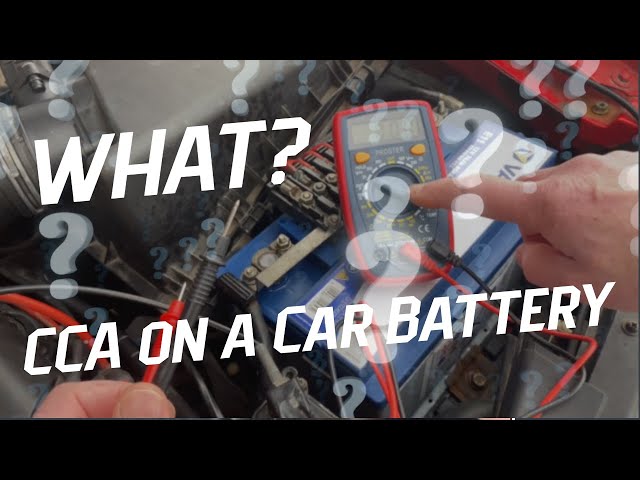
A multimeter helps but gives limited information. A resting voltage test tells you the state of charge but not the actual CCA. A fully charged battery should read 12.6 volts or higher. Below 12.4 volts means it's partially discharged.
The headlight test is a quick sanity check. Turn on your headlights for 10 minutes without starting the engine, then try to start the car. If the headlights dim dramatically or the engine barely cranks, your battery is likely weak.
Carbon pile load testers are the professional standard. They apply a calibrated load that mimics starter motor demands. Most modern testers are electronic and safer than older carbon pile models.
My testing routine goes like this. Every fall, before cold weather hits, I test my battery's voltage and load capacity. I've caught two failing batteries this way, both of which showed full voltage but couldn't deliver under load. One would have left me stuck in a parking lot in December.
When to Replace Your Battery Based on CCA
Most car batteries last 3-5 years, but CCA loss happens gradually, then suddenly. Here's how to know when replacement time is near.
Test results below 80% of rated CCA mean replacement time. If your battery was 700 CCA when new and now tests at 550 CCA, it's losing capacity. It might still start your car on a warm day, but winter is coming.
Visual signs matter too. Corrosion around terminals, swelling or bloating of the case, and low fluid levels (in non-sealed batteries) all signal trouble. These often accompany CCA loss.
Age is a factor. Even if tests look okay, consider replacing a battery that's more than four years old if you face harsh winters. The cost of a new battery is much less than a tow truck or a ruined morning.
Frequent jump starts mean your battery is failing. If you've needed two or more jump starts in the past few months, your battery is on borrowed time.
I learned this lesson the hard way. I ignored the slow cranking for too long, hoping the battery would "come back." It didn't. I was stranded at a grocery store in January. Now I replace batteries preventatively before they leave me stuck somewhere inconvenient.
Choosing Between Standard and Enhanced CCA Batteries
You'll find different battery types offering various CCA ratings. Here's how they compare.
Flooded lead-acid batteries are the traditional choice. They offer good CCA at reasonable prices but require occasional maintenance. They're reliable and well-understood.
AGM (Absorbent Glass Mat) batteries cost more but deliver better performance. They typically have higher CCA ratings for their size, charge faster, and last longer. They're spill-proof and handle vibration better, making them great for trucks and SUVs.
EFB (Enhanced Flooded Battery) technology sits between standard flooded and AGM. They offer better CCA and cycle life than standard batteries at a moderate price increase.
Lithium-ion batteries are starting to appear in some vehicles. They're incredibly light and offer strong CCA, but they're expensive and don't perform well in extreme cold. They're more common in racing applications right now.
For most drivers, a quality AGM battery offers the best balance. The higher CCA, longer life, and maintenance-free operation justify the cost. If you live in extreme cold or have demanding electrical needs, AGM is definitely worth the investment.
Frequently Asked Questions About CCA on Car Batteries
Is higher CCA better for my car battery?
Higher CCA provides more starting power, which helps in cold weather and gives you a safety margin. However, you don't need to overspend. Match your battery's CCA to your vehicle's requirements and climate. A battery with double the CCA you need won't start your car any faster in normal conditions.
What happens if I use a battery with lower CCA than recommended?
Your engine might struggle to start, especially in cold weather. You could experience slow cranking, repeated failed starts, or complete inability to start. Over time, this strains your starter motor and shortens its life. In severe cases, the battery might not have enough power to even turn the engine over.
Does CCA decrease as a battery gets older?
Yes, CCA gradually decreases as a battery ages due to sulfation, plate corrosion, and electrolyte degradation. A battery might lose 20-30% of its CCA over its lifespan. Regular testing helps you catch this decline before it leaves you stranded.
Can I use a battery with higher CCA than my car requires?
Absolutely. Using a battery with higher CCA than minimum requirements won't harm your vehicle. Your starter only draws the amps it needs. Higher CCA provides extra starting power for cold mornings and gives you more reserve capacity for electrical demands.
How is CCA measured and rated?
CCA is measured by loading a fully charged battery at 0°F for 30 seconds while maintaining at least 7.2 volts. The amps delivered during that test become the CCA rating. This standardized test lets consumers compare batteries across brands and models reliably.

Conclusion
Understanding CCA transforms you from someone guessing at battery choices into an informed driver who picks the right power for their vehicle and climate. Remember that CCA measures cold weather starting power, match it to your engine's needs, and don't forget that build quality and warranty matter just as much as the number on the label.
Your car's battery is its heartbeat, especially when temperatures drop. Take ten minutes this week to check your battery's age, test its current strength, and plan for replacement before an emergency strikes. That small effort today prevents frustrating mornings and costly tows tomorrow.
Drop a comment below with your battery experiences or questions. Have you ever been stranded because of battery issues? What's your go-to battery brand for cold weather starting? Let's keep the conversation going and help each other stay powered up through every season.