Picture this: you hop into your car on a freezing Monday morning, turn the key, and nothing happens but a sad little click. Nine times out of ten, the reason traces right back to your battery. As someone who has spent years tinkering under hoods and helping friends jump-start their cars in grocery store parking lots, I can tell you the single quickest check you can do is a simple voltage reading. The good news is, the numbers you need to know are straightforward, and I'm going to walk you through every single one.
What is normal car battery voltage? A healthy car battery reads 12.4 to 12.7 volts when fully charged and resting, with 13.7 to 14.7 volts while the engine is running. I'll explain exactly what those numbers mean, when you should worry, and how to keep your battery living its best life for years to come.
You might think battery voltage is some mysterious mechanic thing, but it's really just basic electrical health. Stick with me, and by the end of this article, you'll know more about your car's electrical system than most casual drivers, and you'll never get stranded because of a bad battery again.
Why Car Battery Voltage Matters More Than You Think
Your car battery is basically the heart of your vehicle's electrical system. It does two huge jobs: it powers all the electronics when the engine is off, and it gives the starter motor that big punch of energy needed to crank the engine to life. Without the right voltage, neither of these things works properly.
I learned this the hard way in college. I had a beat-up old Honda that I never thought to test until one frigid December morning, it refused to start. A friend pulled out a multimeter, and we saw it was barely putting out 11.8 volts. The battery was dying, but it had been slowly losing voltage for weeks. If I had checked it sooner, I could have replaced it on my own schedule instead of calling a tow truck on exam day.
Voltage is the first warning sign of battery trouble. Checking it takes about 30 seconds and saves you from a world of headaches. A weak battery doesn't just leave you stranded, it can also put extra strain on your alternator and starter, causing those expensive parts to wear out way faster.
A normal voltage reading tells you that your battery is holding a proper charge, that your alternator is charging it correctly while you drive, and that you are unlikely to wake up to a dead car. It's the cheapest diagnostic tool you have, and understanding it puts you in control.
Understanding Car Battery Voltage Basics
Let's start with the fundamentals so we are on the same page. Voltage is essentially electrical pressure. Think of it like water pressure in a hose. More pressure pushes more current through the system. Your car battery is a 12-volt system, but the actual number is a bit higher than that for important reasons.
Inside a fully charged lead-acid battery, which is what most cars use, each of the six cells produces about 2.1 volts. Multiply that by six, and you get around 12.6 volts. That is why a healthy, fully charged battery with the engine off will read between 12.4 and 12.7 volts. The exact number depends on temperature, how recently the battery was charged, and its age.
Your car runs on direct current, which is what batteries produce. This is different from the alternating current in your house outlets. The battery's job is to store this electrical energy chemically until your car needs it, then release it on demand.
When you turn the key or push the start button, the battery sends a massive surge of current to the starter motor. That surge can momentarily pull voltage down a bit, which is normal. Once the engine is on, the alternator takes over and replenishes the energy the battery just used, while also powering all the lights, radio, and computers.
Common Voltage Terms You Should Know
Here are a few terms you'll bump into when reading about battery voltage:
- Resting voltage: The voltage when nothing is drawing power, and the battery has been sitting for a few hours.
- Surface charge: A temporary higher voltage reading right after charging or driving, which fades after a short rest.
- Open circuit voltage: The voltage across the battery terminals with no load attached, basically the same as resting voltage.
- Charging voltage: The voltage at the battery terminals when the engine is running and the alternator is charging.
Knowing these will make you sound like a pro next time you're at the auto parts store.
What is Normal Car Battery Voltage When the Car is Off
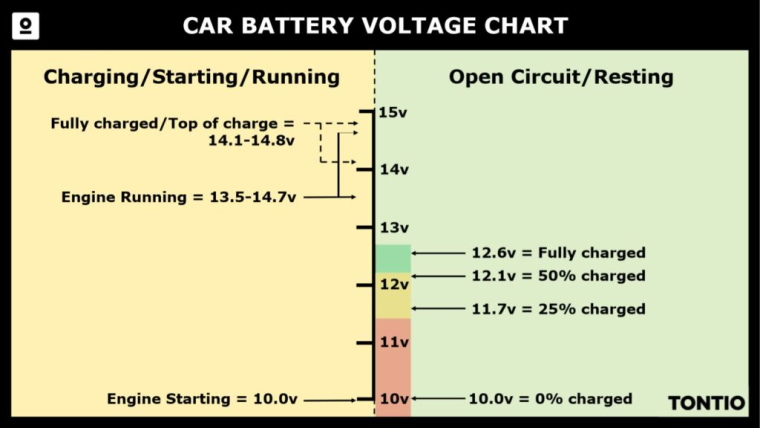
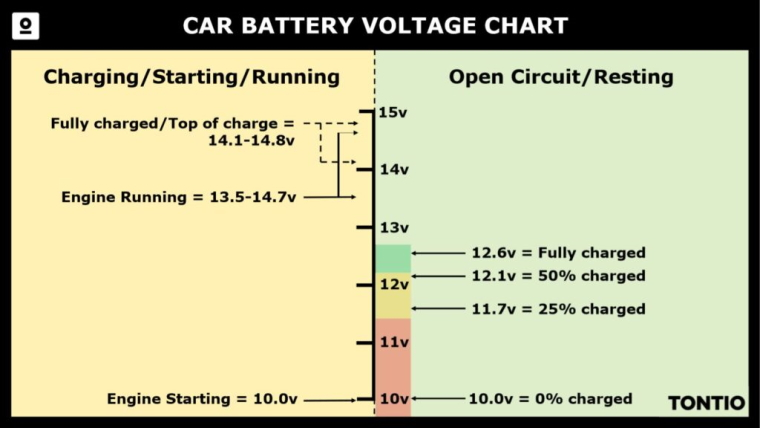
This is the number you want to remember: a healthy battery at rest should show 12.6 to 12.8 volts. Some sources say anything between 12.4 and 12.7 is acceptable, but I always aim for the higher end. The closer you are to 12.6 volts, the more charge your battery is holding.
If you measure between 12.0 and 12.4 volts, your battery is partially discharged. It might still start your car on a warm day, but it's not fully charged. Anything below 12.0 volts means the battery is significantly discharged, and at 11.9 volts or lower, you are looking at a deeply discharged battery that may not crank the engine.
Here's a quick cheat sheet based on my own testing over the years:
- 12.6 volts or higher: Fully charged and healthy
- 12.4 volts: About 75 percent charged, still okay
- 12.2 volts: About 50 percent charged, getting weak
- 12.0 volts: About 25 percent charged, needs charging
- Below 11.9 volts: Discharged, likely won't start the engine
One thing I always tell people: wait at least a few hours after driving before testing resting voltage, or you will get an artificially high reading from surface charge. The best time to test is first thing in the morning before you start the car, or after the car has sat for a solid six to twelve hours.
What is Normal Car Battery Voltage While Driving
Once the engine is running, your voltage reading should jump up. A normal reading with the engine running is between 13.7 and 14.7 volts. Most cars sit right around 14.0 to 14.4 volts when everything is working properly.
This higher number makes sense because the alternator is actively pushing current back into the battery to replace what was used during startup and to run all the accessories. The alternator is basically a generator that converts mechanical energy from the engine into electrical energy.
If your voltage reading is below 13.5 volts while running, your alternator might not be charging the battery properly. If it reads above 15.0 volts, your voltage regulator is probably failing, which can overcharge and damage your battery. I once had a voltage regulator go bad on a road trip and didn't realize it until the battery started boiling over. Trust me, you want to catch that early.
The exact target voltage depends on temperature. In cold weather, the alternator charges a bit higher to offset the battery's reduced efficiency. In hot weather, it charges a bit lower to avoid boiling off the electrolyte. Modern cars handle this automatically through the engine control unit.
What is Normal Car Battery Voltage for Different Vehicle Types
Not every vehicle runs on the exact same battery voltage. While the 12-volt standard covers most cars and trucks, there are some important differences depending on what you drive.
Standard Gasoline and Diesel Vehicles
Your typical sedan, SUV, or pickup truck uses a 12-volt battery. A fully charged one will read 12.6 to 12.7 volts at rest and 13.7 to 14.7 volts while running. This applies to virtually every car made in the last 50 years.
Diesel trucks often use two 12-volt batteries wired in parallel to provide the extra cranking power needed for those big compression-ignition engines. When testing, you measure each battery separately, and both should show the same normal readings.
Hybrid Vehicles
Hybrids like a Toyota Prius or Honda Insight use a high-voltage battery pack to drive the electric motors, but they also have a normal 12-volt battery just like any other car. This little battery powers the computers and allows the hybrid system to wake up. It should show the same 12.6 to 12.7 volts at rest. If your hybrid won't start, the 12-volt battery is often the culprit.
Electric Vehicles
Full electric vehicles don't have a traditional 12-volt battery in the same way, but they do use a small 12-volt battery to power accessories and boot up the main systems. This battery still operates on the same voltage principles. Without it working, your Tesla or Leaf is just a very expensive paperweight.
Classic and Vintage Cars
Older vehicles from the 1950s and 1960s often used 6-volt systems. If you own a classic, you might see a healthy 6-volt battery reading 6.3 to 6.4 volts at rest. These systems are rare today but still out there, especially in restored antiques.
Factors That Affect Car Battery Voltage Readings
Voltage isn't a fixed number. It moves around based on several factors, and understanding them helps you read the numbers correctly.
Temperature Effects
Cold weather is a battery's worst enemy. When temperatures drop, the chemical reactions inside the battery slow down, reducing its ability to hold and deliver charge. A battery that reads 12.6 volts at 70 degrees Fahrenheit might only deliver enough cranking power to make it feel like 12.0 volts at 0 degrees. This is why so many batteries die on the first really cold morning of winter.
Hot weather is also tough on batteries, but for a different reason. Heat accelerates chemical reactions and causes the electrolyte to evaporate faster, leading to permanent damage over time. If you live in the desert, your battery probably won't last as long as one in a milder climate.
Battery Age
As batteries age, their ability to hold a full charge diminishes. A brand-new battery might hit 12.7 or 12.8 volts when fully charged. After three or four years, that same battery might only reach 12.5 or 12.6 volts even after a full charge. If you consistently see lower numbers, your battery is on its way out.
State of Charge
This is the most obvious factor. A battery that just finished charging will read higher than one that has been sitting for a week. Parasitic drains from your car's computer, alarm system, and key fob receivers slowly pull the voltage down over days and weeks.
Surface Charge
After driving or jump-starting, you'll often see a higher voltage reading that doesn't reflect the battery's true state. This surface charge sits on the battery plates and can add 0.5 volts or more to your reading. To get an accurate resting voltage, you need to wait several hours or turn on the headlights for a minute to burn off that surface charge.
How to Test Your Car Battery Voltage Like a Pro
Testing your battery voltage is one of the easiest DIY car maintenance tasks. You don't need to be a mechanic, and the tool is cheap. Let me walk you through how I do it every few months on my own cars.
Tools You Need
You need a digital multimeter. You can buy a basic one for around 15 to 20 dollars at any hardware store or auto parts shop. Some auto parts stores will test your battery for free, but having your own multimeter means you can check whenever you want. Make sure your multimeter can read DC voltage, which is the setting you will use.
Step by Step Testing Guide
- Turn off your car and remove the key from the ignition.
- Make sure all lights and accessories are off, including dome lights and phone chargers.
- Set your multimeter to DC voltage, usually labeled VDC or V with a straight line.
- Connect the red positive lead to the positive battery terminal, marked with a plus sign.
- Connect the black negative lead to the negative battery terminal, marked with a minus sign.
- Read the voltage on the display.
- Compare your reading to the resting voltage ranges we talked about earlier.
If the reading is below 12.4 volts, your battery needs charging. If it is below 12.0 volts, charge it immediately and watch it closely over the next few days. A battery that won't hold above 12.4 volts after a full charge is probably on its way to the recycling center.
Testing While Running
You can also test the charging system by reading voltage with the engine running. Start the car and let it idle. Turn off all accessories like the AC, radio, and lights. Read the voltage at the battery. You should see 13.7 to 14.7 volts. Then turn on the headlights, AC, and radio. Voltage should drop a little but stay above 13.5 volts. If it drops below 13.5 volts, your alternator may be weak.
Signs of a Bad Car Battery Beyond Voltage
Voltage is a great starting point, but it doesn't tell the whole story. A battery can show proper voltage but still fail under load. Here are other signs that your battery is on its last legs.
Slow Engine Cranking
This is the classic symptom. When you turn the key, the engine turns over slowly, like it is struggling. This usually means the battery doesn't have enough cranking amps to do its main task. Even if voltage looks okay, a load test might reveal weakness.
Dim Headlights
If your headlights dim noticeably when you stop at a traffic light but brighten when you rev the engine, your alternator is struggling to keep up. This could mean a weak alternator or a battery that isn't holding charge properly.
Electrical Gremlins
Flickering interior lights, random radio resets, and dashboard warning lights can all point to battery or charging system issues. Modern cars are sensitive to voltage fluctuations, and a weak battery often causes weird computer glitches.
Swollen or Bulging Battery Case
If your battery looks puffy or swollen, especially on the sides, it has probably been exposed to extreme temperatures or overcharging. A swollen battery is a failed battery and needs to be replaced immediately. I once ignored a slight bulge on my car battery and it ended up cracking and leaking acid all over my engine bay. Not a fun cleanup.
Sulfur or Rotten Egg Smell
A sulfurous smell around your battery means it is leaking gas, which usually happens during overcharging. This is both a sign of a bad voltage regulator and a safety hazard because the gas is flammable. Get it checked out right away.
Old Age
Most car batteries last between three and five years. If yours is in that range or older, start paying closer attention to its performance. Even if voltage looks okay, the internal chemistry is breaking down over time.
How to Maintain Proper Car Battery Voltage
Keeping your battery in the healthy voltage range isn't complicated. A little bit of regular attention goes a long way toward avoiding those frustrating dead-battery mornings.
Drive Your Car Regularly
Batteries love to be used. Short trips that only last a few minutes don't give the alternator enough time to fully recharge the battery. If you mostly drive short distances, consider taking a longer highway drive once a week to top off the charge. Cars that sit for weeks without being driven often develop dead batteries.
Keep Terminals Clean
Corrosion on the terminals acts like a layer of insulation, preventing proper current flow. I clean my terminals every six months with a wire brush and a mixture of baking soda and water. You will be amazed how much brighter the headlights look afterward. Just disconnect the negative terminal first, then the positive, clean everything thoroughly, and reconnect positive first, then negative.
Avoid Parasitic Drains
Modern cars have small computer systems that draw power even when the car is off. This is normal and accounts for a tiny loss over time. But if you install aftermarket electronics like stereos, alarms, or phone chargers that are wired directly to the battery, they can drain your battery much faster. Make sure any accessories are wired through a switched circuit or have a proper shutoff.
Use a Battery Maintainer
If you have a car that sits for long periods, like a classic car or a summer-only convertible, a battery maintainer is your best friend. These small devices plug into a wall outlet and keep your battery at a perfect float voltage without overcharging. I use one on my vintage truck all winter and the battery is always ready to go in spring.
Check Voltage Regularly
I test my batteries every three months or so. It takes two minutes, and it tells me everything I need to know about the state of my electrical system. If you have a newer car with a battery sensor, pay attention to any battery warnings on your dashboard.
Common Mistakes When Checking Car Battery Voltage
Over the years, I have seen people make the same mistakes over and over. Avoid these and you'll get accurate readings every time.
Testing Right After Driving
We covered this earlier, but it bears repeating. If you test right after driving, jump-starting, or charging, you'll see surface charge that gives you an inflated reading. Wait at least four to six hours, or burn off the surface charge by leaving the headlights on for a minute before testing.
Testing While the Engine is Idling
Some people test voltage while the engine is running and then panic when they see 14 volts. That is normal charging voltage, not resting voltage. Make sure you know which reading you want before you start testing.
Assuming Voltage Tells the Whole Story
A battery can show 12.6 volts at rest but fail under load. The only way to know if it can actually deliver the amps needed to start your car is to do a load test. Many auto parts stores will do this for free. It takes about 10 minutes and gives you a much more complete picture of battery health.
Ignoring Temperature Effects
A battery that reads 12.2 volts on a cold morning might be perfectly healthy and just temporarily affected by the temperature. Compare readings taken at similar temperatures for the most accurate assessment.
Not Checking the Alternator
Battery voltage problems don't always come from the battery. If your battery keeps dying even after charging, the alternator might be the real culprit. Always check the charging voltage while running to rule out alternator issues.
When to Replace Your Car Battery
Even with perfect care, every battery eventually dies. Knowing when to replace it saves you from getting stranded and prevents the cascade of electrical issues that come with a failing battery.
Replace If Voltage Stays Low After Charging
If your battery reads below 12.4 volts even after being fully charged by a proper charger, it has lost its ability to hold charge. Time for a new one. You can try charging it, but if it won't hold above 12.4 volts, the internal plates are probably sulfated and damaged beyond recovery.
Replace If It's More Than Five Years Before
Age is the biggest factor. Most batteries start to noticeably decline after the four-year mark. If yours is over five years old, replace it preventatively, especially before winter. I have made it a rule to replace my batteries at the five-year mark regardless of how they look. That approach has saved me from countless dead mornings.
Replace If You See Physical Damage
Cracks, bulges, leaks, or heavy corrosion all mean the battery needs replacement now. Continuing to use a physically damaged battery risks acid leaks, electrical shorts, and even fires in extreme cases.
Replace If Load Test Shows Weakness
Many auto parts stores will perform a free load test. The test simulates the high demand of starting the engine and shows how the battery performs under stress. If it fails the load test, replace it.
Frequently Asked Questions
Is 12.2 volts okay for a car battery?
12.2 volts means your battery is about 50 percent charged. It might still start your car on a warm day, but it's not fully charged. If you see this reading regularly, charge the battery and check the charging system. If it keeps dropping back to 12.2 volts, the battery is probably aging out.
Is 11.9 volts bad for a car battery?
Yes, 11.9 volts is considered a deeply discharged battery. At this level, you will likely have trouble starting the car, and continued use can damage the battery permanently. Charge it immediately and watch it closely. If it won't hold a charge above 12.4 volts after a full charge, replace it.
What voltage is too low for a car battery?
Anything under 12.0 volts is too low and indicates significant battery discharge. Below 11.8 volts, the battery is severely depleted and may have permanent capacity loss. Continued operation at these low voltages can damage the battery and other electrical components.
Can a car battery read 14 volts?
A car battery can read 14 volts or higher, but only when the engine is running and the alternator is actively charging it. This is normal charging voltage. If you see 14 volts when the engine is off, your battery is reading surface charge or your meter is not calibrated correctly. A battery at rest should never read above about 12.9 volts.
How often should I check my car battery voltage?
Checking every three months is a good routine for most drivers. If your battery is over three years old, check it monthly. Also check it before and after extreme weather seasons, since heat and cold both stress batteries. If you notice any starting issues, test immediately rather than waiting.
Conclusion
Understanding normal car battery voltage is one of those simple pieces of knowledge that pays off for the entire life of your vehicle. A healthy battery rests at 12.6 volts and runs at 13.7 to 14.7 volts while the engine is on. Anything outside those ranges tells you something important about the health of your battery or charging system.
I have been testing batteries since my very first car, and that habit has saved me countless times from being stranded. It is quick, cheap, and gives you peace of mind. Grab a multimeter, spend two minutes testing your battery today, and start paying attention to those numbers. Your future self will thank you on some cold morning when your car fires right up while others are waiting for jump-starts.
If you found this guide helpful, consider sharing it with a friend who always seems to have car troubles. And feel free to leave a comment with your own battery testing stories or questions. I love hearing from readers and helping out however I can.